The site is solidly built: static, self-hosted, no external scripts, 95–100 on desktop. The risk isn't in the code. It's in one claim in the search result, in mandatory disclosures that are missing, and in three language versions that disagree on the one table that matters.
Above average technically. Exposed where it matters.
All 37 pages pass the technical baseline: canonical set, exactly one H1, no missing alt text, no external scripts. On desktop the site scores 100/95/100/100. The weaknesses sit where a buyer makes decisions: in the first line of the search result, in the availability of the apartments, and in what the site promises about energy and tax.
Assessment by area with the weakest measurement in each area
Area
Verdict
Weakest measurement
Desktop performance
strong
100/95/100/100 on every page tested, LCP 289–508 ms
Mobile performance
two defects
Home CLS 0.1971; /properties 1,766 KiB and LCP 2.0 s
Accessibility
adequate
3.68:1 contrast on a permanently visible element, on 12 of 12 pages
Technical SEO
strong
37/37 canonicals, 37/37 exactly one H1, 0 images without alt
SEO content
gaps
10 descriptions outside the useful range; invisible FAQ markup
Claims and law
weak
“Fully renovated” against “prepared for renovation”; no Energieausweis
Security headers
partial
HSTS present; CSP, XCTO, Referrer-Policy and Permissions-Policy absent
Property data
contradictory
RO and DE/EN give different sales statuses and outdoor areas
Points that need a lawyer's review are marked [Legal review]. The assessment rests on the cited statutes and the legal position, not on a legal review.
The five findings that count
What to fix first — and why.
Ordered by risk, not by effort. Each finding gives the evidence, the consequence and the fix.
P0
The search result promises renovated apartments. What is for sale is unrenovated.
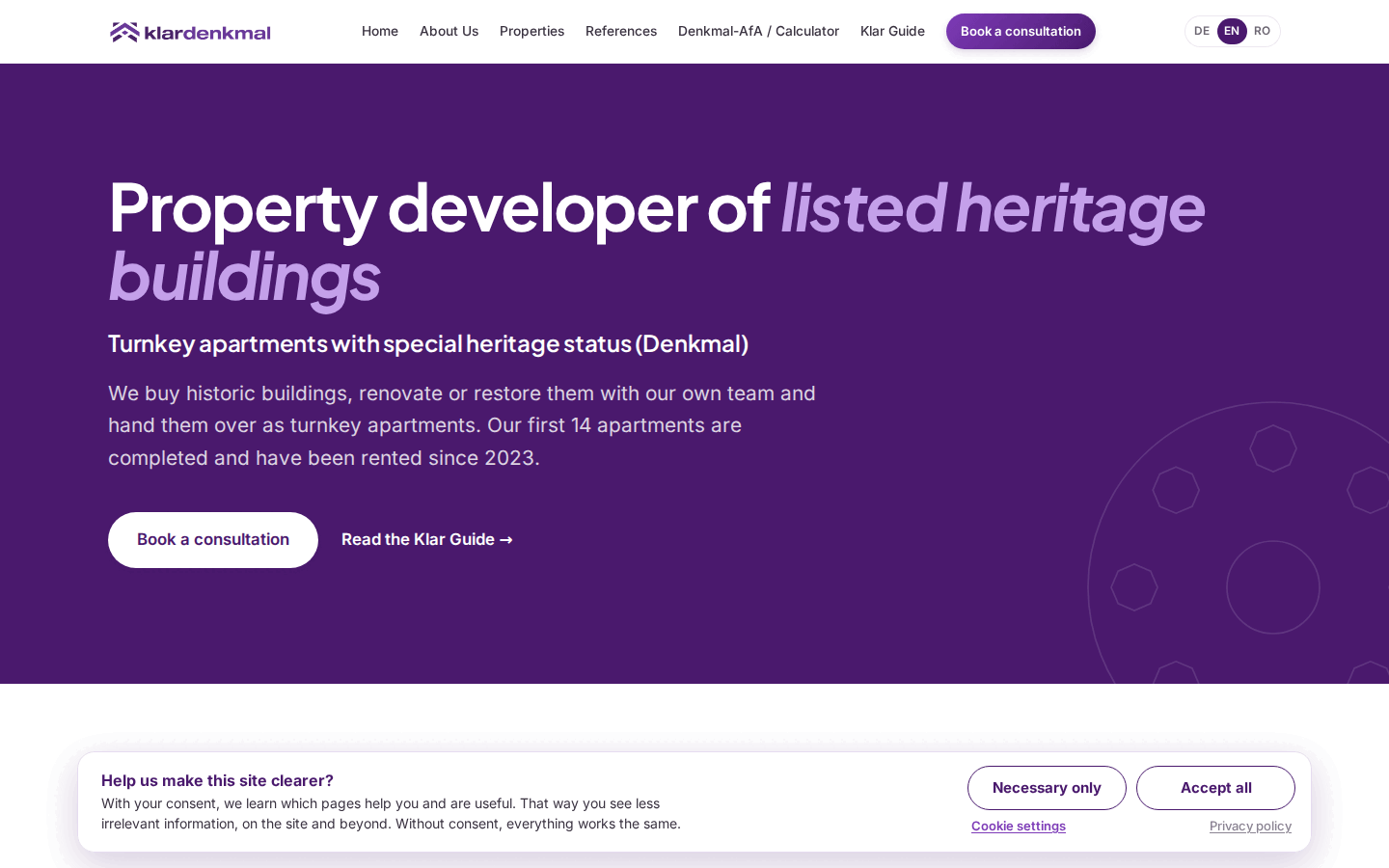
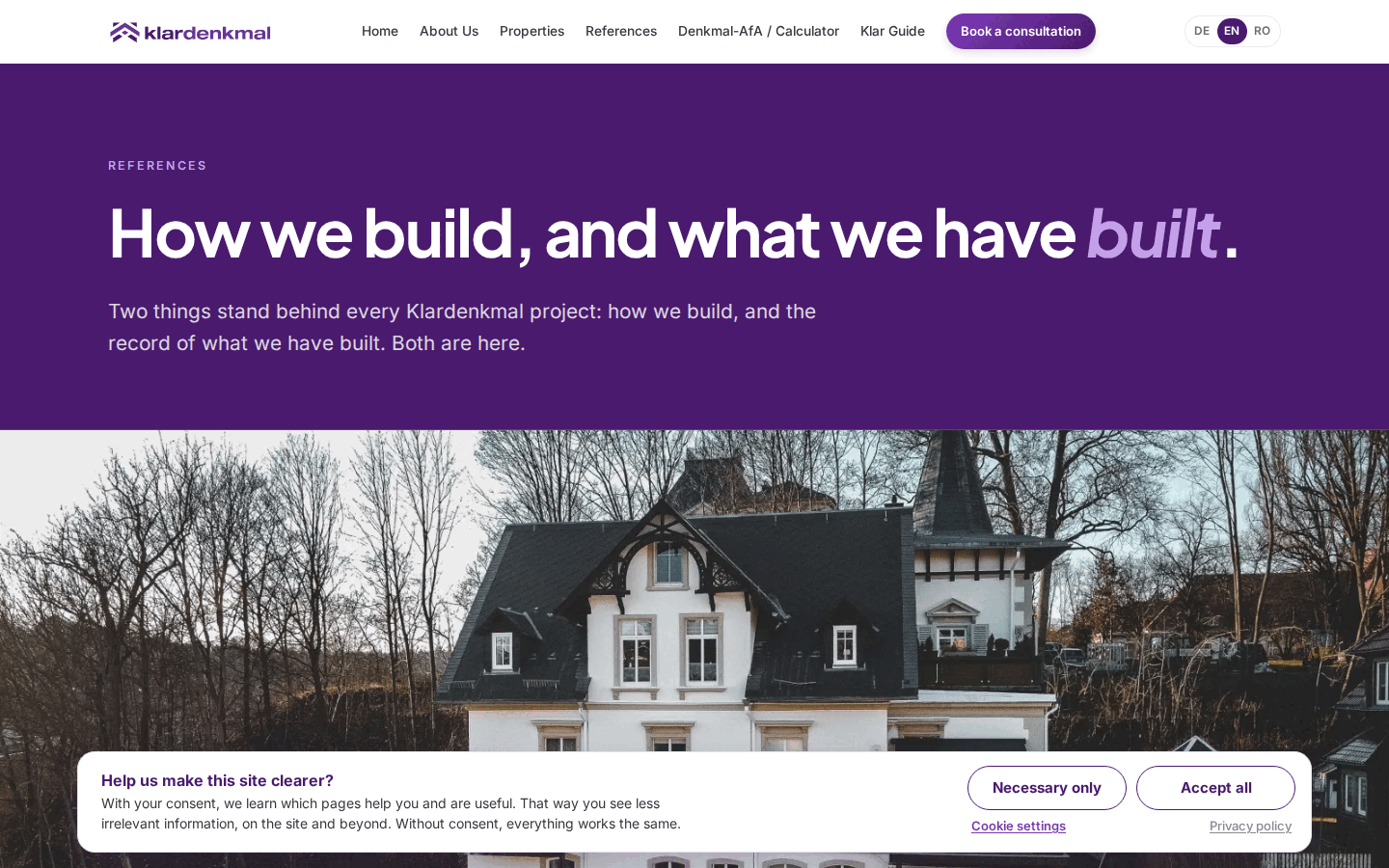
All three home pages say in their meta descriptions that the properties are already renovated. Both current projects describe themselves as prepared for renovation. So the line Google shows first is wrong — and it is precisely the feature that justifies the price.
“Denkmalimmobilien in Plauen, Sachsen — vollständig saniert, mit voller Denkmal-AfA …”
“Monument-protected properties in Plauen, Saxony — fully renovated, with full heritage depreciation. Kraftmar GmbH · HRB 35854 Amtsgericht Chemnitz.”
“Proprietăți monument-istorice în Plauen, Saxonia — complet renovate, cu Denkmal-AfA integral …”
Meta descriptions of the three home pages; DE and RO abridged here
“Sanierungsvorbereitet”
Visible text, Ikle-Reis and Oberlosa project pages
Why it matters
The line in the search result is the first statement about the brand. A material characteristic presented differently in advertising than in the product is the classic pattern of a misleading statement (§ 5 UWG, German unfair competition act). [Legal review]
Fix
Rewrite the three descriptions around what is actually sold: “Listed apartments in Plauen — prepared for renovation, with full heritage depreciation.” Keep “fully renovated” only where it is true: the references. Effort: 15 minutes.
P0
Not one of the 37 pages carries an Energieausweis.
The site quotes a target value for after the renovation. It never quotes an Energieausweis, the German energy certificate: none of the mandatory particulars — final energy demand, energy carrier, energy class — appears on any of the 37 pages. When selling, § 87 GEG requires the certificate data in advertising too.
“Heizenergiebedarf sinkt auf ca. 17 kWh/m²a.” (heating demand falls to roughly 17 kWh/m²a)
Oberlosa, visible text in DE, EN and RO — the only energy figure on the site
Why it matters
GEG § 87 requires the energy certificate data in commercial advertisements for a sale. A projected demand after renovation is not that. The heritage exemption can relax some obligations under § 79 GEG — whether it also reaches the advertising duty needs a lawyer's answer. If an exemption applies, it should be stated; silence reads like a breach. [Legal review]
Fix
A compact certificate block per property — including on the listing cards: type, final energy demand, energy carrier, year, class. If a § 79 exemption applies, one sentence naming it takes its place.
P0
The FAQ markup describes content the page does not show — and contradicts it.
Six pages carry FAQPage markup. The questions and answers exist only in the machine-readable code; none is visible. And in the most important tax example the code says 70 % renovation share, while the visible page says 80 % four times and the calculator runs on 80 %.
“At a 42 % tax rate and a 70 % renovation share, annual savings can amount to several thousand euros.”
FAQPage JSON-LD, heritage-depreciation page
An 80 % renovation share, stated four times in the visible text — while the markup says 70 %.
Rendered text and tax calculator, 80 % as the default
Why it matters
Google's structured data policy requires FAQ content to be visible to visitors; markup alone is a documented trigger for manual action. The contradiction lands on the tax figures — the page's core sales argument. And 70 % is the only number a machine reads.
Fix
Render the FAQ visibly — it improves the page anyway — or remove the FAQPage blocks. Raise 70 % to 80 % everywhere; the calculator is the reference. Effort: about two hours.
P1
The Romanian version marks two apartments as sold that DE and EN show as available.
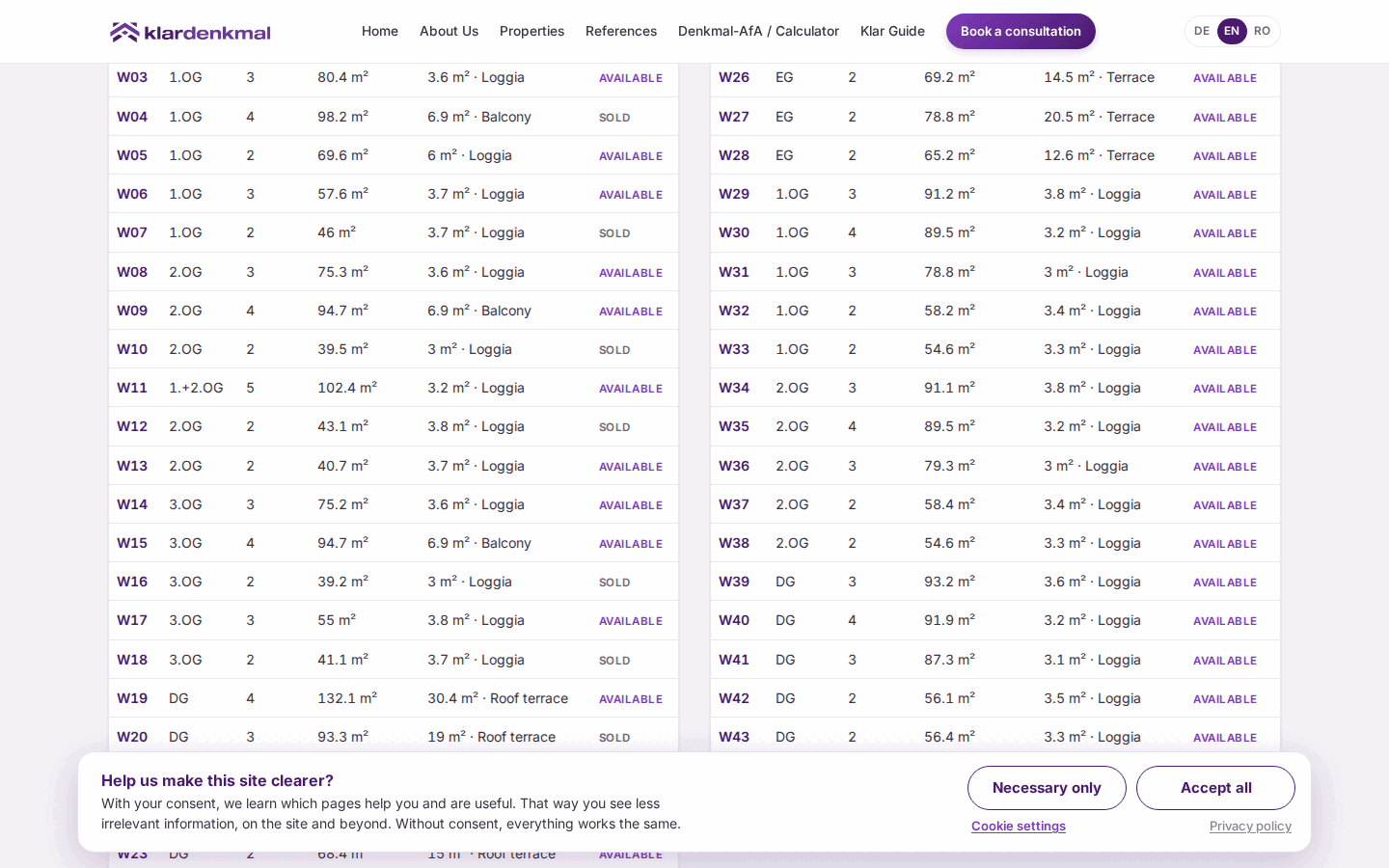
WE1 and WE2 read “Vândut” (sold) in Romanian and “verfügbar” / “available” in German and English. On top of that, every outdoor area in the RO table is roughly double — 42 instead of 21 m² for WE1. One figure is the area countable under WoFlV, the other the gross terrace; nobody says which is which.
WE1 outdoor area: DE/EN 21 m² · RO 42 m². WE2: 12.2 against 24.4 m². WE3: 5 against 10.1 m².
Unit tables on the Oberlosa pages, all three languages, same day
Why it matters
This is a hard factual contradiction in the most decision-relevant table on the site. A Romanian buyer sees two fewer apartments than a German one — on the same day. Doubled outdoor areas are exactly the discrepancy a notary or a bank's valuer will question.
Fix
One source for all units (a single JSON file used by all three language versions). Choose one area convention and name it: “living space under WoFlV” or “terrace, gross”. Effort: about an hour.
P1
The enquiry path loses the visitors who have already decided.
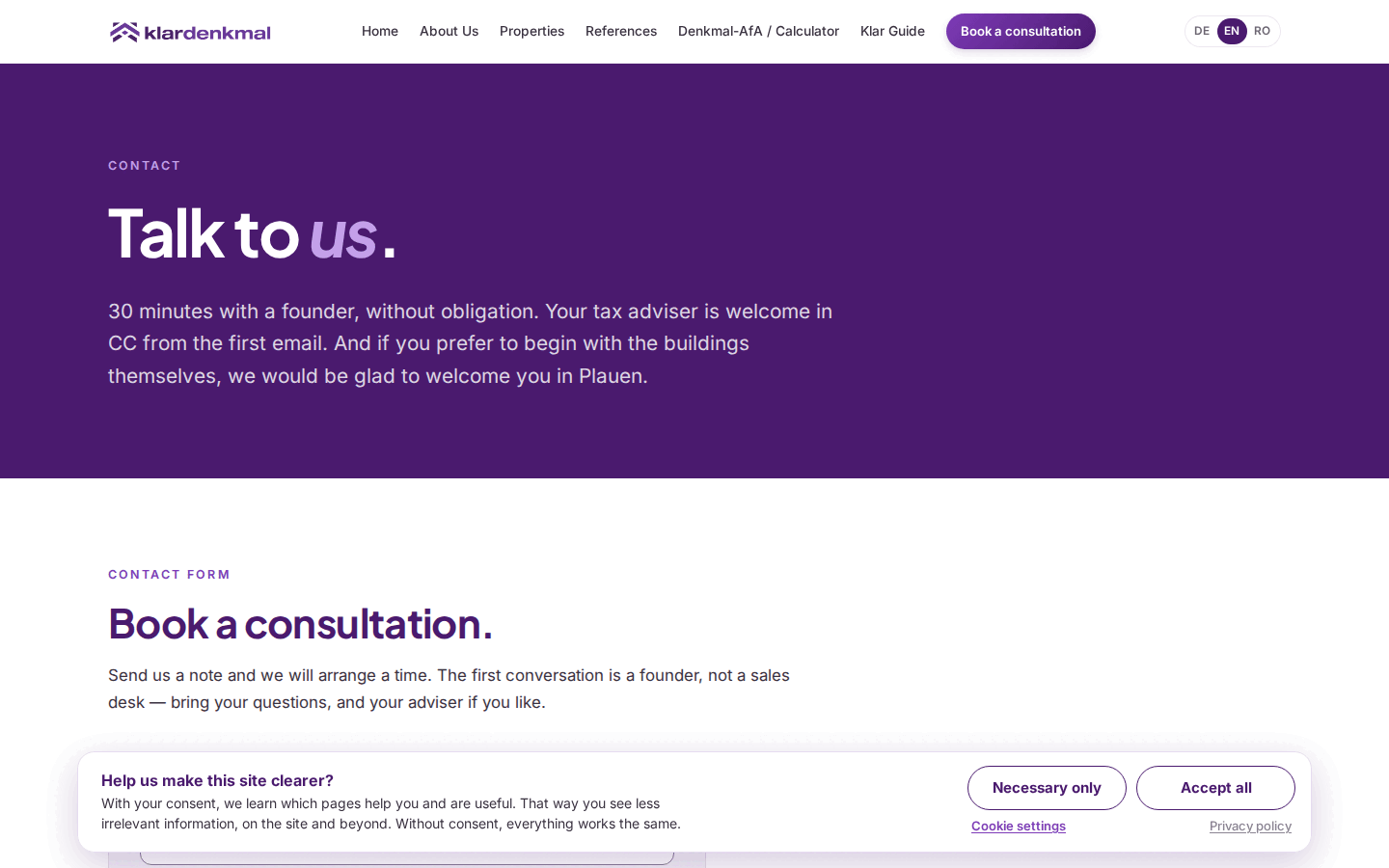
Someone who reaches a unit page has done the hard part. Then there is no price, no exposé to download, and every button leads to an empty /contact page — and the form asks for name, e-mail, country and message, but not for a phone number and not for the apartment. Out of 43 units, the buyer has to describe which one they mean.
“Floor plans, finishes per unit and pricing are in the full exposé — request it below.”
Project page, visible text
Form fields: name, e-mail, land, nachricht, berater_cc, gdpr — plus the website honeypot.
Lead form, all three languages
Why it matters
The visitor on a unit page has already made the hard choice. Asking them to re-describe which of 43 apartments they mean is unnecessary effort — and a phone call is the most common next step in property, yet it isn't asked for.
Fix
A button per property carrying a query parameter that pre-fills the form. A “request the exposé for this unit” button with name, e-mail and phone. Add the phone field. Send property and unit with the lead. Effort: one day.
Further findings
What else stands out.
Compact, by area. Every point is evidenced; full quotes are in the detailed report.
Law and compliance
The Impressum cites § 5 TMG — repealed in May 2024, now § 5 DDG. Plus two links to the ODR platform, closed in 2025. [Legal review]
Four Romanian legal pages are missing: /ro/imprint, /ro/impressum, /ro/risikohinweis and /ro/steuerlicher-hinweis return 404.
Ikle-Reis promises MaBV staged payments three times but publishes no completion date and no construction schedule.
Property data
KfW Effizienzhaus 70 EE appears only in the visible Romanian text — a concrete financing argument stays invisible in the smallest market.
The Oberlosa address on the detail page lives only in an image's alt text, not in readable copy.
References without third-party proof: no customer quote anywhere, no review profile. The Villa Weststraße “After” image is a guide illustration; Rötha shows “In progress” with After photos.
Performance
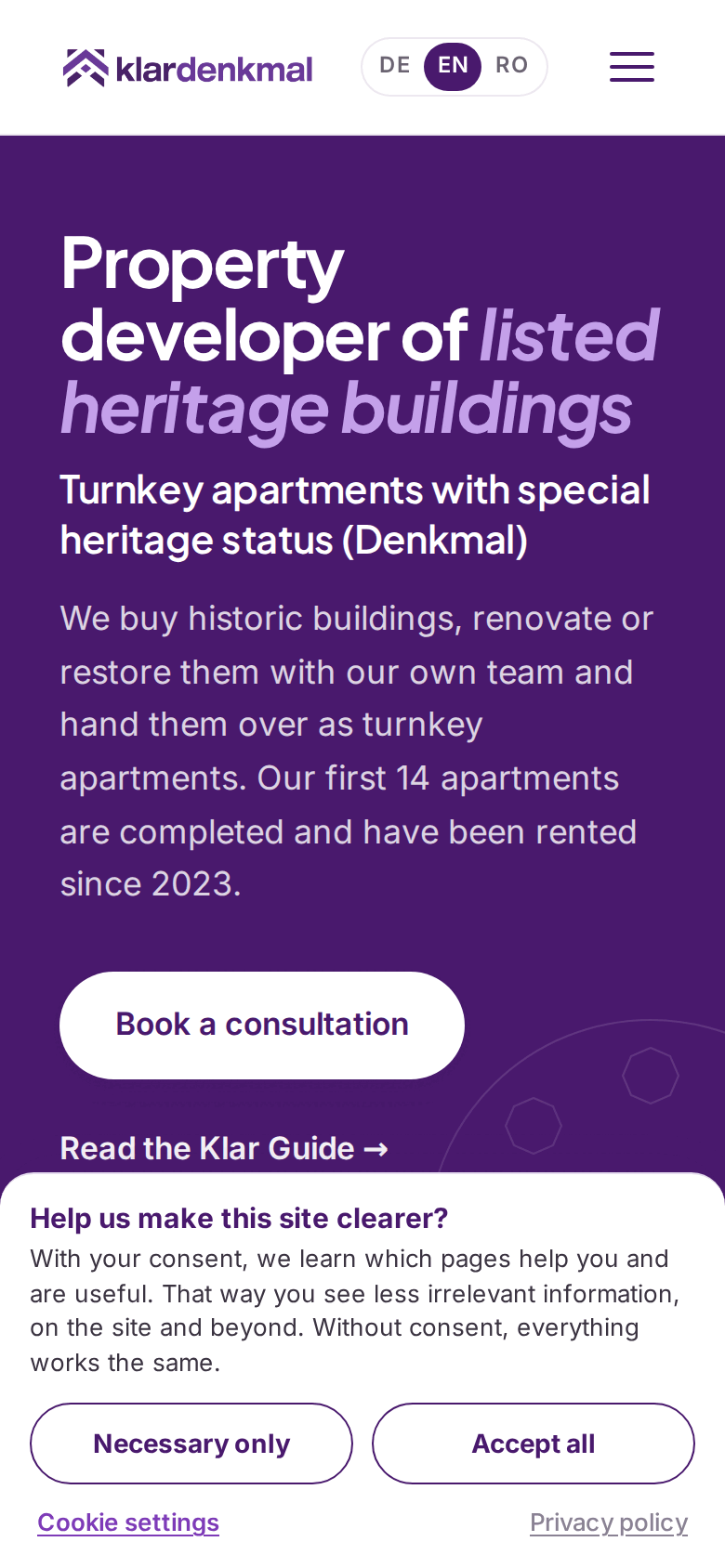
CLS 0.1971 on the mobile home page: a font swap moves the hero line by 66 px; Plus Jakarta 700/600 are not preloaded.
/properties on mobile: 1,766 KiB, LCP 2.0 s. Three images weigh 542, 437 and 329 KiB.
Cache policy: everything arrives with max-age=0, must-revalidate, hashed assets included.
Accessibility
3.68:1 contrast on .kdk-bar-privacy, 13 px, on all 12 pages tested — one token change fixes it.
Unit tables have no <caption> or scope; of three scroll wrappers, only one can be reached by keyboard.
21 elements keep their entrance animation under prefers-reduced-motion.
SEO and structured data
Ten descriptions outside the useful range (33 to 223 characters); one title over length.
One og:image for all 37 pages — every shared page looks the same.
Figures and chapters disagree: Oberlosa 1663 in the JSON-LD against 1583 in the text; “7 chapters” against “8 steps”.
Guides with no author, date or sources — the weakest spot for E-E-A-T on tax content.
Security
Four headers missing: CSP, X-Content-Type-Options, Referrer-Policy, Permissions-Policy. HSTS is present.
A strict CSP is realistic — no external scripts, two iframes (OSM, YouTube nocookie).
Wildcard DNS, no takeover path: 11 subdomains probed — ten answer with Vercel's 404, www redirects with a 308.
Screen evidence
What we saw.
Captured on 22 November 2026, desktop 1440 × 900 and mobile 390 × 844.
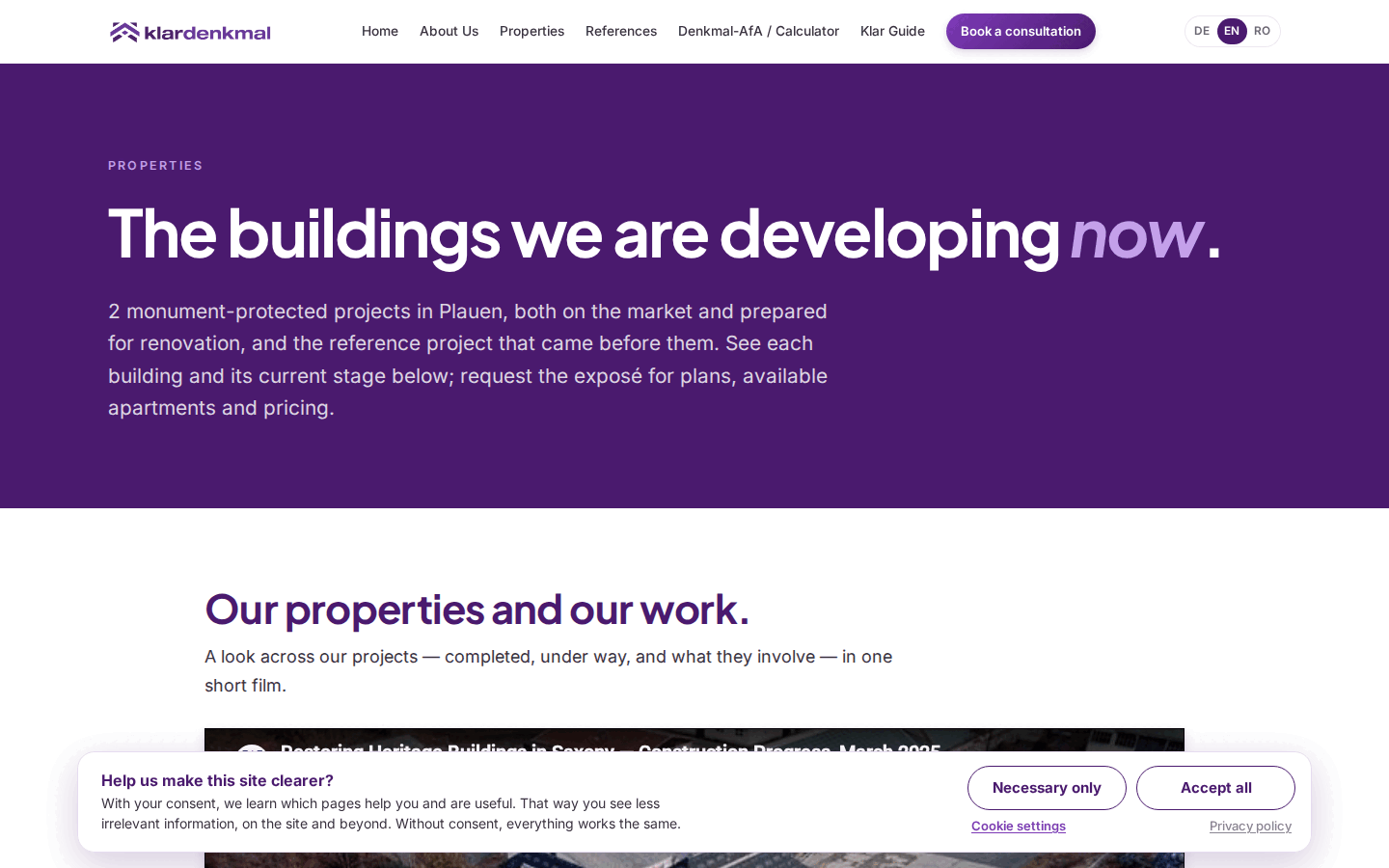
Home page. The promise stands large in the hero. Both current projects describe themselves as prepared for renovation on their own pages.Property overview. Two projects, 43 units — no price, no availability indicator.Unit table. 43 apartments with areas and status, no column headings in the crop. The contradictory statuses are in the Oberlosa table.Contact form. Name, e-mail, country, message. No phone field, no property reference — although every button leads here.References. Not a single customer quote, no review profile; one “After” image comes from the guide.Home page, mobile. Measured: the hero text jumps 66 px while loading — CLS 0.1971, caused by the font swap.
The action plan
The order to do it in.
P0 before any campaign. P1 this sprint. P2 next cycle.
P0 — this week
Claims and machine-readable contradictions. Four items, about five hours in total plus legal review.
P0 — actions 1 to 4, this week
#
Action
Effort
1
Rewrite the three home meta descriptions; remove “fully renovated”
15 min
2
Render the FAQ visibly or remove FAQPage; reconcile 70% with 80%
2 h
3
Energieausweis block per property — or one sentence on the § 79 exemption [Legal review]
2 h + review
4
Unify Oberlosa availability and area convention across RO/DE/EN
1 h
P1 — this sprint
Everything that costs conversion or access.
P1 — actions 5 to 12, this sprint
#
Action
Effort
5
Preload hero font weights 700/600, metric-match the fallback — CLS to 0
2 h
6
Compress the three images over 300 KiB; AVIF and fetchpriority on the LCP image
3 h
7
Per-property button with a pre-filled form; phone field; exposé request
1 day
8
Publish the Ikle-Reis construction schedule and MaBV payment plan
Content
9
Move the Impressum to § 5 DDG, remove the ODR links [Legal review]
30 min
10
Translate and link the four missing RO legal pages
3 h
11
Contrast token to at least 4.5:1; table caption/scope and focusable wrappers
2 h
12
CSP, XCTO, Referrer-Policy and Permissions-Policy in vercel.json
1 h
P2 — next cycle
Substance and trust. No emergency, but the difference between good and credible.
P2 — actions 13 to 20, next cycle
#
Action
13
An og:image per property instead of one graphic for every page
14
Rework the ten too-short or too-long descriptions; fix the ro__klar-guide title
15
Give guides a named author, a “last updated” date and two or three sources
16
Customer quotes, a Google Business profile and sameAs; real “After” photos
17
Targets to at least 24 × 24 px; reduced motion as a global rule
18
Cache-Control for hashed assets
19
Fix or remove the 1663 value in the Oberlosa JSON-LD; replace “7 chapters” with “8 steps”
20
Name KfW 70 EE in visible EN and DE copy
What is already good
The foundation holds.
These should survive every change — they are why the fixes are so inexpensive.
Built static, everything self-hosted: zero external scripts, zero external images, one form action, two iframes. That's why a strict CSP is possible at all.
Desktop performance: 100/95/100/100 on every page tested, TBT 0, CLS 0.0.
Technical SEO skeleton: canonical on 37/37, exactly one H1 on 37/37, no image without alt, hreflang on every page, a real 404 status.
Responsive integrity: 14 widths from 320 to 1920 px, 12 pages — no horizontal overflow.
Honest schema: PreOrder and AskPrice instead of invented prices or ratings.
Three genuine language versions, not a translation widget — each with its own canonical.
Method and limits
How it was measured — and what wasn't.
Measured
37 pages fetched in full: HTML, headers, text, metadata, JSON-LD.
Lighthouse 13.6.0, 14 runs — mobile for every key page, desktop for three.
axe-core 4.11.0 on 12 pages.
CLS probe with PerformanceObserver and source rectangles, three scenarios.
Responsive sweep: 14 widths × 12 pages, overflow and tap targets.
Subdomain recon: 11 hosts resolved and actively probed.
Not tested
No test lead sent, no CRM or backend tested — only what the browser sees.
No load test, no penetration test; the security pass is a header and attack-surface review.
No legal opinion: legal points are cited and marked, not decided.
No field data — every value is a lab measurement.
Execution
All CPU-heavy measurements ran on two separate worker servers; the production machine was not loaded. Every number in the report comes from a saved artefact; none is estimated.
Quotes were checked against the fetched HTML in a second pass. Two early machine findings (“HSTS missing”, “heritage depreciation missing on Ikle-Reis”) turned out to be false and are not in the report.